
National 1 League and What It Means for Clubs Across Ohio
Interview: Ed Bernstein on the Launch of National 1 League
As the youth soccer landscape continues to evolve, one of the biggest developments heading into the 2026-27 season is the launch of the National 1 League (N1) — a new collaboration between US Club Soccer and US Youth Soccer designed to create a more unified team-based pathway for clubs across the country.
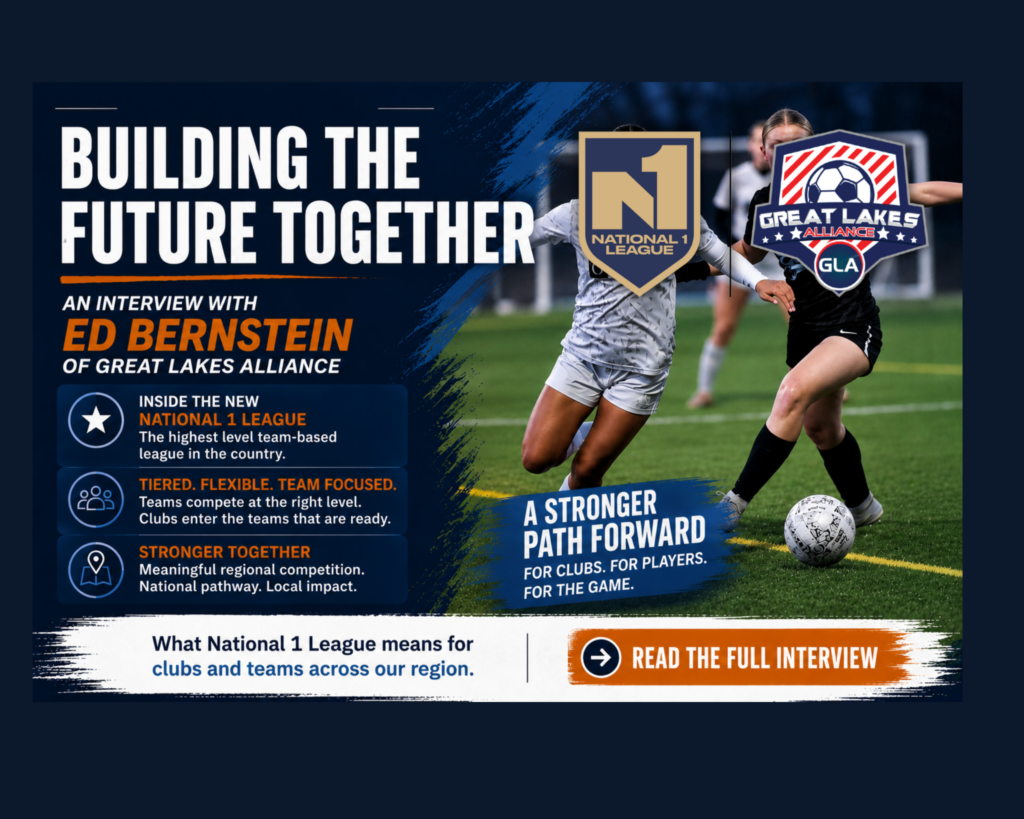
Great Lakes Alliance is an OSMD Insider and paid sponsor of Soccer Moms & Dads, LLC. If you would like more information about the GLA N1 league or Great Lakes Alliance other leagues you can visit their website at www.glasoccer.com.
For clubs and families throughout Ohio, Pennsylvania, Michigan, Indiana, Kentucky, West Virginia, and Western New York, the announcement carries major implications. Great Lakes Alliance has been named one of the founding league operators for the platform.
We sat down with Ed Bernstein of Great Lakes Alliance to talk about what the National 1 League actually is, why it matters, and what clubs should expect moving forward.
Q: There has been a lot of conversation about the National 1 League. For families and clubs that are still trying to understand it, what exactly is the National 1 League?
Ed Bernstein:
At its core, the National 1 League is about alignment and creating a clearer pathway for clubs and teams. For a long time youth soccer has had multiple organizations, multiple league structures, and a lot of fragmentation. This partnership between US Club Soccer and USYS is an effort to bring more unity to the competitive landscape while still allowing leagues and clubs to maintain their identity.
The biggest thing people should understand is that the National 1 League is a team-based platform built around meaningful regional competition with a national postseason pathway. It creates opportunities for clubs that may not fit into certain club-based models but still provide very high-level soccer.
Q: Great Lakes Alliance was selected as a founding league operator. What does that mean for clubs in this region?
Ed Bernstein:
It means our region will be heavily involved in shaping what this looks like moving forward. Great Lakes Alliance already has strong relationships with clubs throughout Ohio and the surrounding states, and we’ve spent years building competitive regional leagues.
Because of that infrastructure, we are in a good position to help implement National 1 League in a way that makes sense geographically and competitively. Although our district is large, we are able to leverage the density and volume of teams in geographic divisions to group teams to further reduce travel. We understand the travel realities of Midwest soccer families. We understand competitive balance. We understand the importance of reducing unnecessary travel while still creating meaningful games.
For clubs in our region, it means access to a nationally connected platform without immediately jumping into a model that may not fit their club structure or resources.
Q: One of the biggest concerns families always have is travel. How does National 1 League address that?
Ed Bernstein:
That was one of the most important conversations from the beginning. The goal is not to create excessive travel for the sake of saying teams are playing nationally. The focus is regionalized competition first.
The Great Lakes region has enough quality clubs and players to create strong competition close to home. We want teams spending more time developing and less time sitting in cars or hotels every weekend.
Of course, there will still be opportunities for showcases and postseason events, but the weekly league model is designed to make more sense for families.
Q: There are already a lot of leagues and pathways in youth soccer. Where does National 1 League fit?
Ed Bernstein:
National 1 League is designed to become the highest level team-based league platform in the country. What makes it different is that it is built around flexibility and competitive balance for clubs and teams throughout the region.
The GLA N1 structure will be tiered, allowing teams to compete at the level that best matches their development and competitive level rather than forcing clubs into a one-size-fits-all model. That creates stronger games, better developmental environments, and more meaningful competition throughout the league structure.
Another important piece is that clubs are not required to field teams in every age group to participate. A club may have one or two age groups ready to compete at the highest level, and this platform allows those teams to do that without requiring the entire club to fit into a rigid structure.
For many clubs throughout the Great Lakes region, that flexibility is extremely valuable. It allows clubs to stay true to their identity while still providing top-level competition and a nationally connected pathway for their players.
Q: What do you think this means for clubs that are not considered “mega clubs”?
Ed Bernstein:
Honestly, I think this is one of the most important parts of the conversation.
There are a lot of excellent community clubs and mid-sized clubs throughout this region doing tremendous work developing players. Not every family is looking for the same experience. Not every club needs to become a massive organization with multiple satellite locations to provide value.
National 1 League creates another avenue for clubs to compete at a high level while staying true to who they are. Clubs can continue focusing on development, community, and culture while still participating in a respected competitive structure.
That matters.
Q: What should clubs and teams expect over the next year?
Ed Bernstein:
There will be a lot of education and communication. Anytime something new launches, there are questions, assumptions, and speculation. Our job is to provide clarity and help clubs understand where they fit.
We’re focused on building conferences that make sense competitively and geographically. We’re focused on creating quality experiences for players and families. And we’re focused on making sure clubs understand that this is intended to be collaborative.
The reality is that youth soccer continues to evolve. Clubs want better competition. Families want better experiences. Players want pathways. National 1 League is an effort to respond to those needs in a thoughtful way.
Q: Final thoughts for families trying to make sense of the changing youth soccer landscape?
Ed Bernstein:
The biggest thing I would say is don’t get too caught up in labels.
League names matter less than having good coaches, good leadership, a healthy environment, and a pathway that fits your child and your family. There are many ways for players to develop and succeed in this sport.
National 1 League is another opportunity for clubs and teams in our region to compete at a high level while staying connected to a broader national structure. We’re excited about what that can become over time.
As youth soccer continues to shift toward larger regional and national structures, the launch of National 1 League represents another significant step in the ongoing evolution of the game in the Midwest and beyond.
Great Lakes Alliance was named the N1 League operator for Midwest District 1 which includes all of Ohio except for the Cincinnati area which is included in Midwest District 2 which is being operated jointly by Ohio River League, Ohio Soccer Association, Kentucky Soccer Association and Indiana Soccer Association.
For clubs throughout the Great Lakes region, the coming months will likely bring important decisions about league affiliation, travel, player pathways, and long-term development models. But according to Bernstein, the focus remains simple: creating meaningful competition while keeping players and families at the center of the experience.
Author Disclosure: When I am not sharing the good news about youth soccer I am also a marketing consultant, and Great Lakes Alliance is currently a client.